Why the Oldham County KY Real Estate Market Carries Higher Taxes
August 13, 2026
August 13, 2026
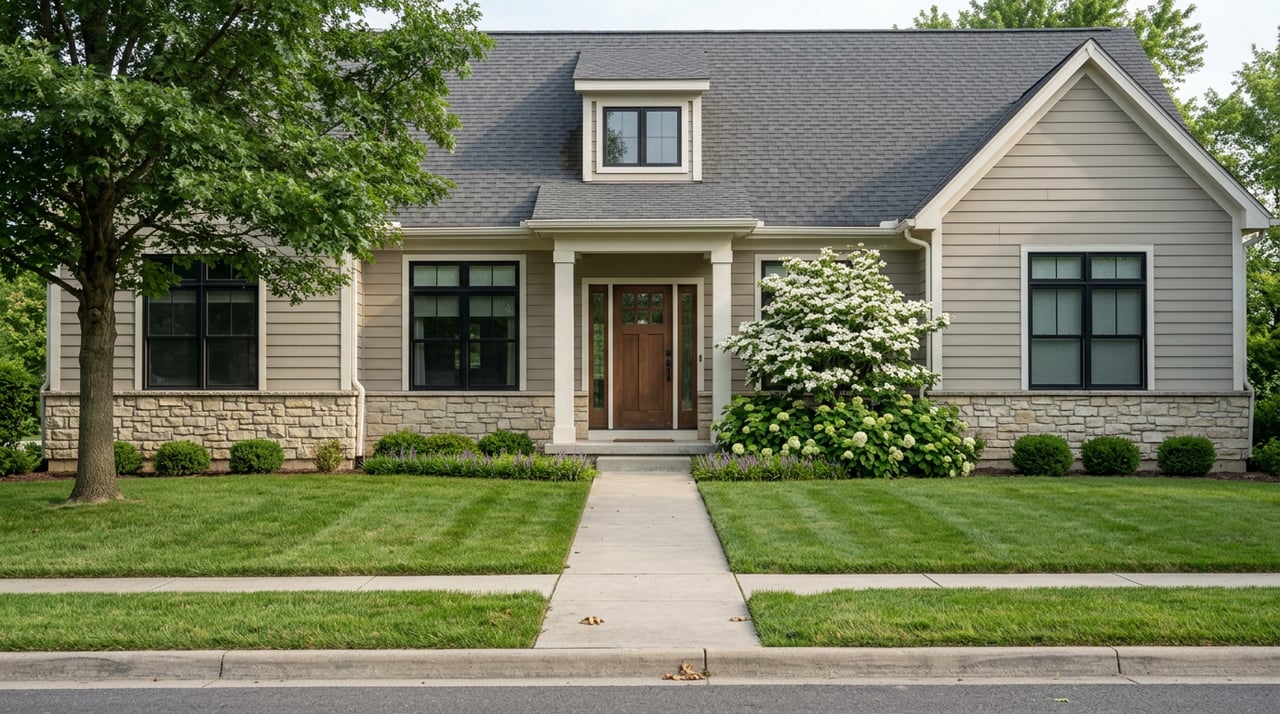
A buyer we worked with last spring had two listings printed out on her kitchen table, both tagged "Oldham County" by the same portal search. One was a two-bedroom bungalow two blocks from the CSX line in downtown La Grange, close enough that she could hear the horn from the porch. The other was a two-story brick colonial on a private lake lot in Crestwood, on the opposite side of the county. Same county. Same school district name on both listing sheets. Nothing else about them matched.
That's the trap in how Oldham County gets marketed online. A single median price gets quoted as if it describes one place, when it actually describes five towns with almost nothing in common except a shared property tax bill that happens to be the highest in Kentucky. Understanding why that bill is so high, and why the tax rate itself isn't the reason, tells you more about what you're actually buying here than the median ever will.
Start with the rate, because it's the part buyers assume is doing the damage. According to Ownwell's 2026 county tax data, Oldham County's median effective property tax rate runs 1.23 percent of assessed value. Jefferson County's, by the same measurement, runs 1.14 percent. That's a nine-hundredths-of-a-point gap. It is not the reason anyone's bill triples.
What actually separates the two counties is the number the rate gets multiplied against. World Population Review's 2026 property tax rankings put Oldham County's median annual tax bill at $3,454, the highest of Kentucky's 120 counties, ahead of even Campbell County near Cincinnati and Fayette County around Lexington, according to TaxByCounty's 2026 breakdown. Jefferson County's median bill, per SmartAsset, sits at $2,223 on a countywide median home value of $257,100.
Run the arithmetic and the mechanism becomes obvious. Oldham's rate is barely above Jefferson's. Its home values are the variable doing all the work. Every one of the five towns inside the county sits on a higher price floor than most of Jefferson County, and a nearly identical millage rate applied to a higher floor produces a bill that looks dramatically different even though nobody voted to raise it.
That price floor is not uniform, either. It moves by more than $240,000 depending on which of the county's five main markets you're looking at, and each one earns its price tag for a completely different reason.
La Grange is the county seat and the closest thing Oldham County has to a walkable downtown. CSX freight trains still run down the middle of Main Street, a detail the city built an entire tourism identity around, and the historic district holds a working mix of small businesses, from a barbershop to an art gallery to a frame shop that's been open since 1975. The town recently designated its downtown core, known locally as the R.A.I.L. District, as an official Entertainment Destination Center, letting visitors carry a drink between participating restaurants and bars within marked boundaries. Trinity Fitness cut the ribbon on a new gym at 118 East Main Street this past April, one more sign of steady small-business turnover on a Main Street that never had to be reinvented, just refilled.
Crestwood is the county's construction engine. New subdivisions here include Brentwood, a nine-phase build-out across 41 acres of preserved green space with homes starting at 2,000 square feet and values soaring well into the $1 million range, and Summerfield By The Lake, a waterfront community built out by The Jones Group, Landis Homes, and Fine Home Builders, with floor plans running past 4,000 square feet around a private lake. Creekstone, one of the newest subdivisions, sits close enough to the I-71 Buckner exit that its buyers are effectively purchasing proximity to a grocery store as much as a floor plan.
Pewee Valley is the opposite of Crestwood in almost every respect. It has two National Register Historic Districts and individually listed homes dating back to the 1850s, among them Woodside and Bemersyde, both built in 1857, and The Beeches, from 1902. New construction is rare enough that a single small development, The Coterie at Denison Lane, with six one-acre estate lots, counts as major local news. That scarcity produces an odd statistical wrinkle worth flagging before it misleads anyone: because so few new homes get built there, the handful that do sell can pull the town's new-construction median well below what the historic housing stock actually commands. A low new-build number here is a symptom of small sample size, not affordability.
Prospect and Goshen sit at the top of the county's price ladder, the towns most buyers picture when they hear "Oldham County luxury." Prospect itself straddles the Jefferson-Oldham county line, and it is the Oldham County slice, along KY-42, that carries the county's highest new-construction prices, with Goshen close behind. These are the towns doing the heaviest lifting on the county's overall median.
Here's what that spread looks like in current new-construction pricing across the five towns:
| Town | Current new-construction median price | Defining feature |
|---|---|---|
| La Grange | $361,466 | Walkable historic Main Street with a working freight line |
| Crestwood | $428,503 | Active subdivision development, lake and acreage lots |
| Pewee Valley | $326,286 | Historic housing stock, new-build scarcity skews the number low |
| Goshen | $450,095 | Larger acreage, quieter luxury tier |
| Prospect | $569,567 | The county's highest price tier |
The clearest evidence that this county is still actively sorting itself, rather than sitting still, sits at the intersection of Commerce Parkway and Highway 393 in Buckner, between Crestwood and La Grange. Kroger opened a 106,000-square-foot store there on November 1, 2023, its first ground-up store build in the Louisville region in 14 years, with a fuel station featuring the state's first 20-pump layout for the chain.
That store is no longer standing alone. The Oldham County Planning and Zoning Commission approved plans on June 23, 2026, according to The Oldham Era for a roughly 30-acre mixed development directly across the street, informally called Buckner Commons, combining a home improvement store, a grocery store with an attached liquor store, and six smaller commercial parcels for additional retail or office space. County planning staff noted the site is projected to generate more than 100 peak-hour vehicle trips onto a road that currently carries about 2,000 trips a day, a sign of how much retail density is about to land on a stretch of highway that had almost none five years ago. The development isn't expected to open until 2028, but the zoning approval already tells you where county growth is heading next, and it's not toward any one of the five towns individually. It's toward the corridor connecting them.
Put the tax data and the town-by-town spread together and the real story of Oldham County comes into focus. This is a county where a nearly ordinary tax rate produces an extraordinary bill, because every sub-market inside it, from the most affordable Main Street bungalow to the newest lake-lot colonial, sits on a higher price floor than most comparable Kentucky counties. Buyers who assume they're being taxed more aggressively here are misreading the mechanism. They're not paying a steeper rate. They're paying the same rate on a floor that starts higher no matter which of the five towns they choose.
That has a practical consequence worth sitting with before you tour anything. A buyer comparing a $400,000 home in Crestwood against a $400,000 home just across the county line in Jefferson County is not comparing two similarly taxed properties. The Oldham County home, even at a rate close to Jefferson's, will likely carry a materially higher annual bill, not because Oldham decided to charge more, but because the county's overall value base pulls every property's assessment up with it. That's a carrying-cost conversation worth having early, not after an offer is already in.
Does the tax rate vary between the five towns themselves? Yes, modestly. Local school and fire district levies stack on top of the base county rate, so a home in one subdivision can carry a slightly different bill than a similarly priced home a few miles away, even within the same town.
Is the low Pewee Valley new-construction number a real deal? Treat it as a data artifact, not a bargain. With so few new lots available, one or two sales can swing the median significantly. The town's actual value sits in its historic housing stock, which trades on scarcity and preservation, not on a new-build comparison.
Will the Buckner Commons development change home values nearby? It's too early to know with certainty since the project won't open until 2028, but new retail density at a highway interchange has historically supported nearby residential demand in this corridor, and it's worth watching as construction timelines firm up.
If you're comparing towns inside Oldham County, or comparing Oldham County against a Jefferson County suburb altogether, the median price on a portal will not tell you which bill you're actually signing up for. Greg Sokoler and the team can walk you through the real carrying costs, town by town, before you fall for a number that was never describing just one place.
This article is general information, not legal, tax or financial advice. Consult a qualified professional about your situation.
When you work with The Sokolers, you’ll immediately understand why clients think of Greg and Casey as dedicated specialists who have mastered the skills needed for evaluating, marketing, and matching buyers and sellers.
10525 TIMBERWOOD CIR LOUISVILLE KY 40223